












A simple way to determine the correct rotation direction of an independent motor fan
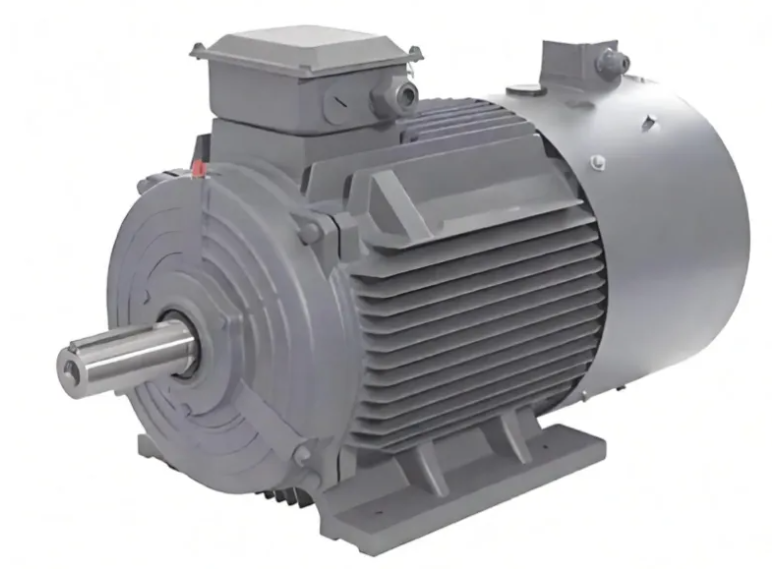
For the independent fan of the IC416 forced air-cooled inverter motor, rotation direction verification is a mandatory item after installation, overhaul, or replacement. Many on-site commissioning personnel only check if the fan is rotating, ignoring the airflow direction. The fan may appear to be operating normally, but if the rotation direction is reversed, the cooling airflow will be significantly reduced, easily causing the motor to overheat at low speeds. This is also one of the causes of heat-induced leakage of the sealant in the high-voltage motor slot. To determine the fan rotation direction, prioritize confirming the airflow direction, rather than simply observing whether the impeller rotates clockwise or counterclockwise. The core principle is: the independent fan is installed at the non-drive end (rear end) of the motor. In the correct state, air should be drawn in from the outer mesh cover of the fan, blown towards the motor body, pass through the air duct of the base, and finally discharged from the exhaust ports at the front of the motor or on both sides of the base.
The first step is label verification, which is the most basic preliminary check. Standard fans typically have either an arc-shaped rotating arrow or a straight airflow arrow printed on the shroud or casing. These arrows indicate the standard rotation direction and airflow direction. The observation angle must be fixed: stand outside the fan (the side furthest from the motor) and observe the impeller. If the impeller's rotation direction matches the arrow on the casing, it is the design-specified rotation direction. It's crucial to distinguish between the two types of arrows: the arc-shaped arrow represents the impeller's rotation direction, and the straight arrow represents the airflow direction; these should not be confused. If there is no label, confirmation must be based on airflow testing; subjective judgment based solely on the appearance of the blades is insufficient.
The second step is an on-site jog airflow test, which is also the most commonly used and reliable judgment method in engineering. During operation, use short-duration jogging, pay attention to safety, and keep away from the rotating fan blades. Take a thin piece of paper, tissue, or smoke and place it on the outside of the fan's air inlet mesh. If the paper is sucked towards the fan mesh, and hot air can be felt blowing out of the motor's front outlet while the paper floats outwards, it indicates that the airflow path conforms to the design and the direction is correct. If air blows outwards from the outside of the fan and no airflow is discharged from the motor outlet, it is a typical case of reverse rotation. Once an axial flow fan reverses, the airflow is usually only 30% to 50% of the rated value; after a centrifugal fan reverses, the air pressure is almost completely lost, resulting in a false cooling phenomenon of "the fan is running, but the motor is not cooling down," which is extremely difficult to detect.
The third step can be used to verify the operating parameters. When the direction is correct, the fan operating current is within the nameplate rated range, and the noise is stable; if the direction is reversed, the fan noise becomes abnormally louder, and the current deviates from the rated value. After confirming the airflow direction, it is also necessary to check whether there are large areas of air leakage in the fan shroud and flange joints, as air leakage will also reduce the effective cooling airflow. It is particularly important to note here that the independent fan rotation direction and the main motor rotation direction are independent of each other. Regardless of whether the main motor rotates forward or backward, the airflow direction of the independent fan must remain fixed.
Once a three-phase independent fan is confirmed to be in the wrong direction, it can be corrected by swapping any two phase wires. For a single-phase capacitor fan, the capacitor wiring needs to be adjusted. After the fan's direction is checked, it is recommended to run it under no-load for a period of time to monitor the motor temperature rise and ultimately verify the cooling effect. The hidden dangers caused by incorrect direction have a delayed effect; initially, it will not trip immediately, but sustained high temperatures will accelerate the aging of the winding insulation, and long-term operation will induce major faults such as partial discharge and insulation damage. Therefore, every time an independent fan is newly installed, overhauled, or replaced, the fan's direction and airflow check must be the first step in commissioning to ensure that the airflow path is qualified before putting it into load operation.
 XINDA