











Motor protection level classification standard
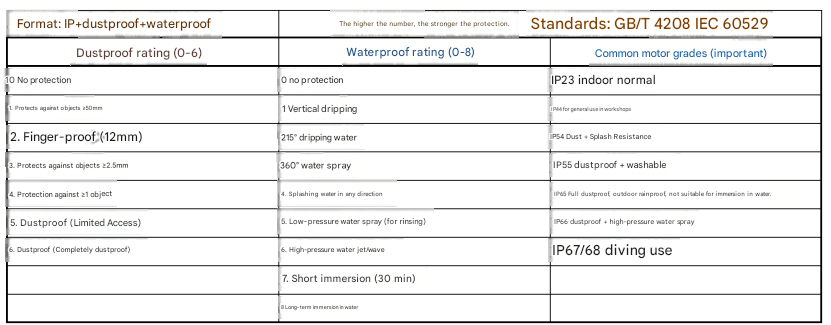
The classification of motor protection ratings primarily relies on the International Classification of Protection (IP) standard. The IP standard is a standard used to classify and specify the level of protection that electrical equipment can withstand against external objects and moisture. This standard was developed by the International Electrotechnical Commission (IEC) and is widely adopted globally. An IP rating consists of two digits: the first indicates the dustproof rating, and the second indicates the waterproof rating. Each digit has a specific meaning.
The IP65 protection rating for motors is an internationally recognized standard used to measure the ability of a motor enclosure to protect against solid foreign objects (such as dust) and liquids (water). "IP" is an abbreviation for "Ingress Protection".
● The first number, 6: Completely dustproof. This is the highest level of dustproof rating. It means that the motor housing can completely prevent dust from entering. During testing, the sample is placed in a standard dust chamber for 8 hours, requiring no dust accumulation inside.
●The second number, 5: Water-resistant. This means the motor can prevent harmful effects from low-pressure water jets from any direction. During testing, a 6.3 mm diameter nozzle is used to spray water onto the motor at a flow rate of 12.5 liters per minute from a distance of 3 meters for at least 3 minutes.
With complete dust and water resistance, IP65-rated motors are ideal for use in harsh industrial environments with risks of dust and water splashes. Common applications include:
●Outdoor LED Display Screen
●Industrial control cabinet
● Charging stations
●Occupations with combustible dust, such as those involving grain, timber, and chemicals.
For example, some explosion-proof motors designed specifically for dusty environments (such as certain series from Beide and Wannan Motor) adopt an IP65 protection rating to ensure safe and reliable operation in environments such as flour processing or chemical production.
Precautions and Professional Tests
Although IP65 provides a high level of protection, the following points should still be noted in practical applications and product certification:
●Dynamic and aging risks: Vibration during motor operation may cause deformation of the seals, and after long-term use, the sealing materials (such as rubber rings) may also age and harden, thus affecting the protective performance.
●Temperature Influence: The water temperature during testing should be consistent with the ambient temperature to avoid seal failure due to thermal expansion and contraction.
●Professional Testing: To ensure that the product truly meets the IP65 standard, it is recommended to choose a third-party laboratory with CNAS (China National Accreditation Service for Conformity Assessment) or CMA (China Metrology Accreditation) qualifications for professional testing. These institutions have precise equipment and standardized procedures, and can provide test reports that are widely recognized in the market.
 XINDA
XINDA