













How to choose a motor for a conveyor platform?
In automated production lines, logistics conveying, and the design of non-standard equipment, the selection of the motor for the conveyor platform directly determines whether the equipment can operate stably, whether its energy consumption is reasonable, and whether its lifespan meets the standards. Choosing the wrong motor can result in insufficient power and malfunctions, or even overload and burnout, and increased maintenance costs.
Many engineers only consider power when selecting motors, neglecting the core thrust requirement, leading to selection errors. Today, we'll guide you step-by-step through precise motor calculations, focusing on the thrust of the conveyor platform. The entire process includes formulas and practical examples, making it easy for beginners to quickly get started!
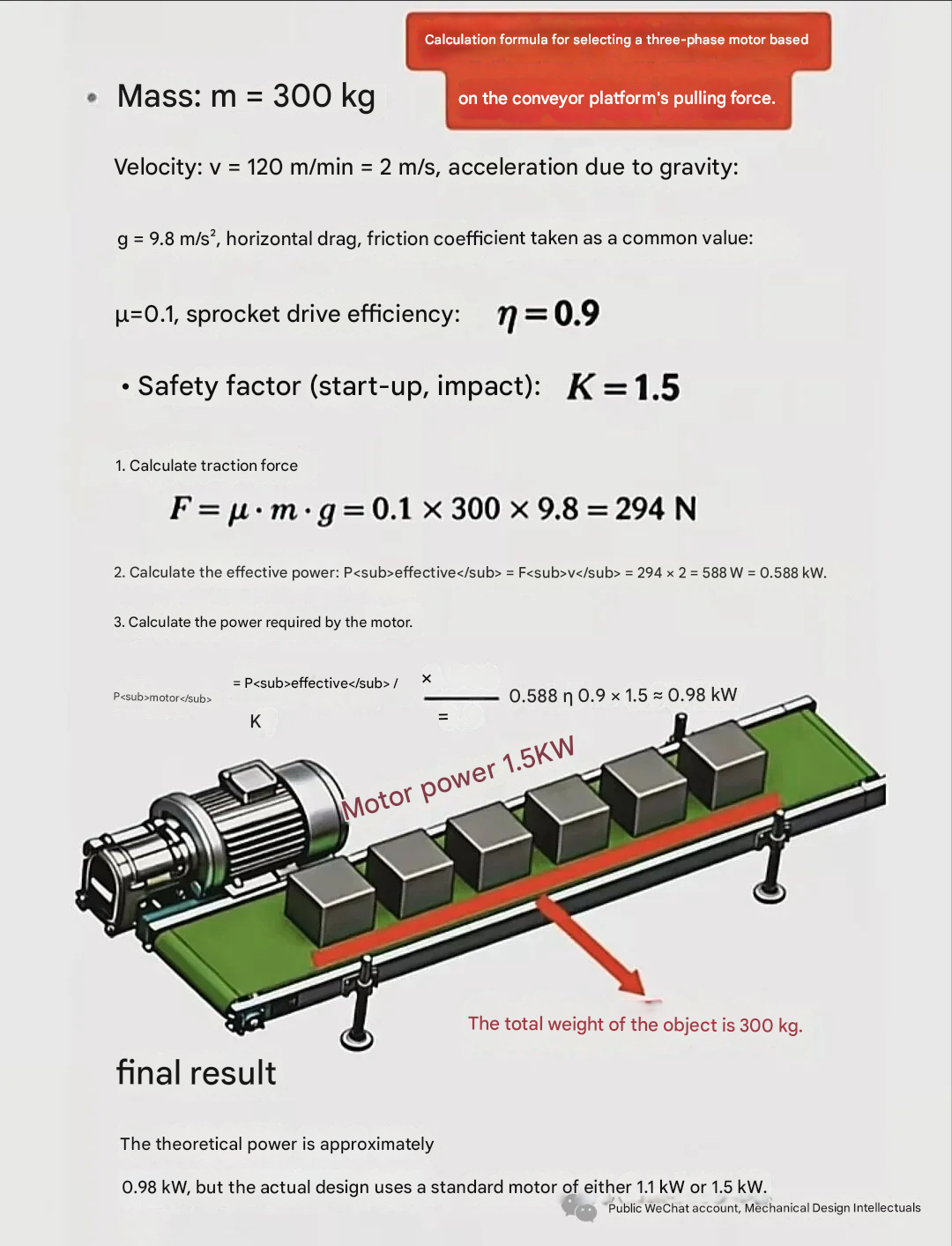
The conveyor platform is a linear motion load. The core function of the motor is to overcome various resistances and propel the platform to move smoothly. The total thrust here is the minimum power that the motor needs to output.
If the thrust is insufficient, the motor will not be able to drive the load; too much thrust redundancy will result in wasted costs and high energy consumption. Only by accurately calculating the required thrust first, and then matching the motor power, torque, speed and other parameters, can we follow a scientific selection logic.
II. Core Steps for Selecting a Motor for a Conveyor Platform (Based on Thrust Calculation)
Step 1: Review the core operating parameters of the conveyor platform
Before performing calculations, it is essential to collect basic data, which is a prerequisite for accurate model selection. The following parameters need to be clarified:
1. Total load capacity (m): Weight of the conveyor platform itself + weight of the material being carried, unit: kg
2. Operating speed (v): Rated operating speed of the platform, unit: m/s
3. Acceleration (a): Acceleration during the start-up/acceleration phase, unit: m/s² (generally taken as 0.1-0.5 m/s², which can be appropriately increased for high-speed equipment).
4. Coefficient of friction (μ): Determined according to the type of guide rail; μ = 0.01-0.05 for rolling guide rails, μ = 0.1-0.3 for sliding guide rails, and μ = 0.05-0.1 for roller guide rails.
5. Transmission efficiency (η): The efficiency of transmission methods such as chains, belts, and gears, generally taken as 0.7-0.9.
6. Safety Factor (k): A safety margin is reserved to cope with sudden loads, wear, and other situations; typically 1.2-1.5.
Step 2: Calculate the total thrust required by the conveyor platform
Total thrust is the resultant force that overcomes friction and acceleration. The core formula is:
Total thrust Ftotal = (Friction force Ffriction + Acceleration force Facceleration) × Safety factor k
1. Friction calculation: The resistance that the platform needs to overcome when running at a constant speed.
F_molybdenum = m × g × μ
(g = 9.8 m/s², gravitational acceleration)
2. Acceleration force calculation: The power required for the platform to rise from rest to its rated speed.
F_addition = m × a
Step 3: Calculate the required torque for the motor based on the total thrust.
Conveying platforms typically use lead screws, synchronous belts, or gear drives. The linear thrust needs to be converted into motor torque. The core formula is:
- Lead screw drive: T = (F_total × Lead P) / (2π × η × i)
- Synchronous belt/gear drive: T = (F_total × radius R) / (η × i)
(T = motor torque, unit N·m; P = lead screw, unit m; R = radius of synchronous pulley/gear, unit m; i = reduction ratio)
Step 4: Calculate the rated power of the motor
Once the torque is determined, calculate the power based on the motor speed. The formula is:
P = (T × n) / 9550
(P = motor power, unit kW; n = motor rated speed, unit r/min)
Step 5: Match motor model
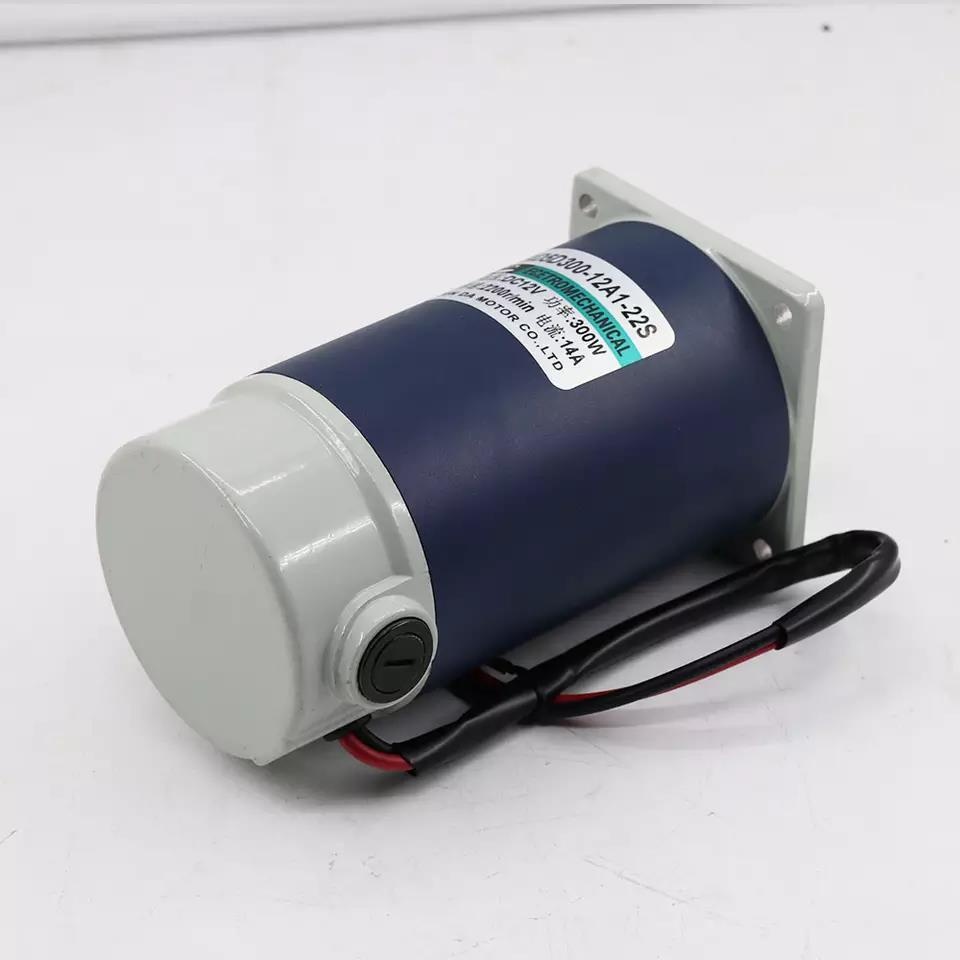
Based on the calculated power, torque, and speed, and considering the operating requirements (speed regulation, positioning, protection level), select the motor type:
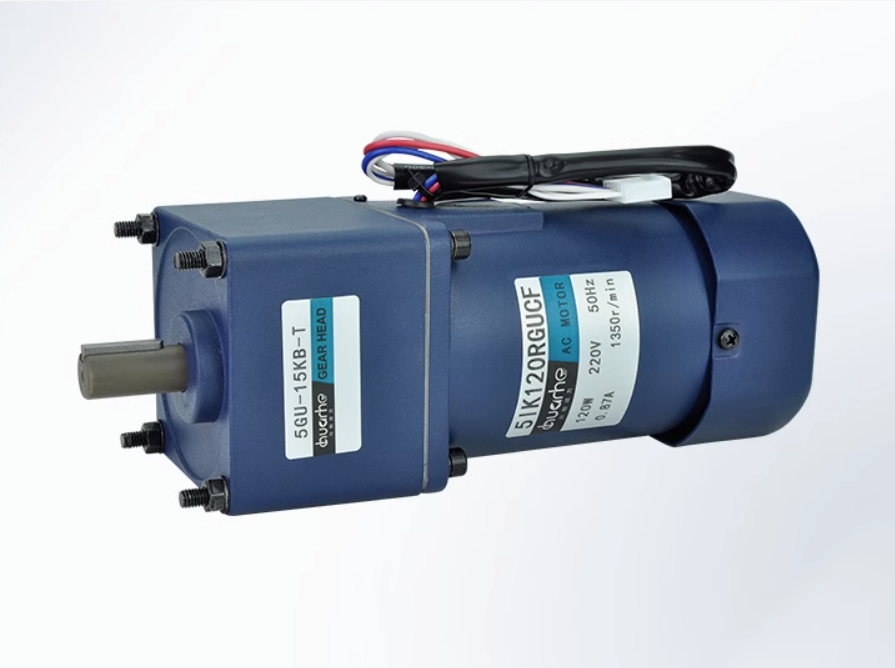
- Standard conveyor line: AC asynchronous motor + speed reducer
- Speed adjustment/precise positioning: servo motor
- Light load, low speed: Stepper motor
- Heavy-duty, long-distance: Variable frequency motor
III. Practical Case Study: Calculate it step by step and understand the selection logic in seconds
Case Background
The parameters of a horizontal conveyor platform in an automated workshop are as follows:
- Platform weight + total weight of materials: 500kg
- Rated operating speed: 0.3m/s
- Acceleration time: 0.5s, acceleration a = 0.6m/s²
- Guide rail type: Roller guide rail, friction coefficient μ=0.05
- Transmission method: Screw drive, lead P=0.01m, transmission efficiency η=0.8, reduction ratio i=10
- Safety factor k=1.3
Calculation process
1. Calculate friction force
F_mo = 500 × 9.8 × 0.05 = 245N
2. Calculate acceleration force
F_plus = 500 × 0.6 = 300N
3. Calculate the total thrust
F_total = (245 + 300) × 1.3 = 708.5N
4. Calculate motor torque
T = (708.5 × 0.01) / (2 × 3.14 × 0.8 × 10) ≈ 0.14N·m
Considering the reducer losses, the actual required motor torque is ≥0.17 N·m.
5. Calculate motor power
Assume the rated speed of the motor is n = 3000 r/min
P = (0.17 × 3000) / 9550 ≈ 0.053kW
Based on common market models, a 0.1kW servo motor with a torque ≥0.2N·m was selected, which fully meets the requirements.
Case Conclusion
The final selection for the conveyor platform was a 0.1kW servo motor + a 10-speed reducer, which met the thrust requirements, had no performance redundancy, and kept costs under control.
IV. Avoidance Guide: Common Selection Mistakes You Shouldn't Make!
1. Focusing only on power, ignoring thrust: Power is a comprehensive parameter. Different motors have significantly different torques, so focusing solely on power makes it easy to choose a motor with insufficient torque.
2. Neglecting safety margins: Lack of redundancy makes the system prone to insufficient power due to load fluctuations or equipment wear.
3. Incorrect friction coefficient value: The wrong coefficient was selected for the guide rail type, leading to deviations in thrust calculation.
4. Ignoring transmission efficiency: Selecting the motor directly based on theoretical thrust, neglecting transmission losses, results in insufficient actual motor output.
V. Summary
The core of selecting a motor for a conveyor platform is to first calculate the thrust, then the torque and power. The steps are clear and the formulas are fixed. As long as the parameters are collected accurately, the motor can be precisely matched.
Whether you're a novice engineer or an equipment maintenance worker, mastering this method will eliminate the need for guesswork based on experience, allowing you to easily select motors for various conveyor platforms, resulting in more stable equipment operation and more reasonable costs!
 XINDA
XINDA