











Tempering and aging processes in motor manufacturing
Heat treatment is an important part of the manufacturing process for motor components. Some components only undergo one processing step, while others require two or even three heat treatment processes. Today, we will discuss several heat treatment processes with you.
I. Tempering Process
Tempering is a heat treatment process following quenching. It involves heating the hardened parts to below their critical temperature and then cooling them in air or oil. Tempering helps parts achieve stable microstructure and dimensions, eliminates or reduces internal stresses after quenching to achieve the required hardness, and improves the toughness of the quenched parts. It is generally used for alloy steel, high-carbon steel, and low-carbon steel parts.
II. Conditioning Process
Tempering is a heat treatment process performed after quenching, specifically high-temperature tempering after quenching. Some special-purpose motor shafts require tempering. The purpose is to give the parts better mechanical properties; to lay the foundation for subsequent heat treatment; to prevent cracking or deformation during later heat treatment processes; to improve the machinability of the material; and to enhance the fatigue strength and wear resistance of the parts.
III. Aging Process
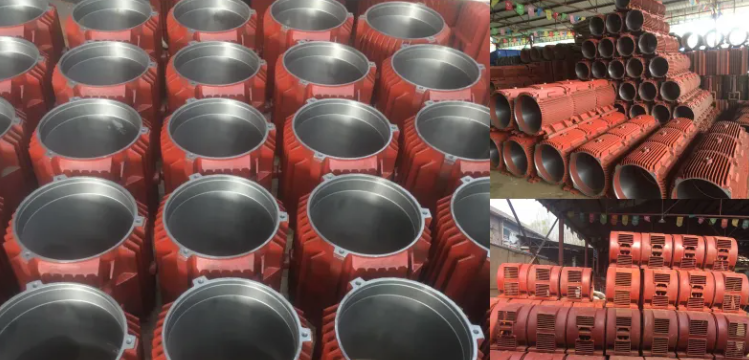
Aging is divided into two types: heated aging and ambient temperature aging. Heated aging involves heating the workpiece to a certain temperature (generally controlled between 120 and 160 degrees Celsius) and holding it at that temperature for 6 to 36 hours. Ambient temperature aging involves natural aging at room temperature, which takes a relatively long time, requiring no less than 6 months, and is generally controlled at 6 to 18 months.
In motor products, the aging treatment of castings is crucial. Many motor manufacturers pre-purchase certain common components to ensure better aging treatment. After aging treatment, the deformation of the components after machining will be reduced, and the internal stress of machining can be effectively eliminated, which has a good promoting effect on ensuring the mechanical properties of the whole product.
 XINDA
XINDA