









The types and selection methods of automatic rotating tables
Date:2025-12-04 Author:Shandong Xinda Motor Co., Ltd.
This section introduces the structure and working principle of automatic rotating tables, detailing their types and selection methods to provide you with a practical guide.
---
Part One: Types of Automatic Rotating Tables
Automatic rotating tables can be classified according to different dimensions. The main classification methods are as follows:
I. By Drive Method and Structure
This is the most fundamental classification method, directly determining the rotating table's performance, load-bearing capacity, and price.
1. Friction Wheel Drive Type
· Principle: The motor, after reduction, directly drives one or more friction wheels made of rubber/polyurethane material, relying on friction to rotate the turntable under the tabletop.
· Features:
· Advantages: Simple structure, low cost, very quiet operation, no gear meshing noise.
· Disadvantages: Limited driving torque, may slip under heavy loads; friction wheels wear out after long-term use and need to be replaced.
· Applications: Home use, light commercial use, display tables with low load-bearing requirements.
2. Gear-Driven Type
* Principle: The motor drives the tabletop via a multi-stage reduction gear set, with the small gear on the output shaft meshing with a large-diameter internal or external gear ring to drive the table.
* Features:
* Advantages: Precise transmission, high torque, extremely high load-bearing capacity, no slippage, long lifespan.
* Disadvantages: Complex structure, higher cost, slight operating noise may occur if gear machining precision is insufficient.
* Applications: Heavy-duty commercial applications (such as large banquet tables, heavy-duty industrial displays), industrial turntables requiring high-precision positioning.
3. Direct-Drive Type
* Principle: Uses a torque motor or direct-drive motor; the rotor is directly connected to the tabletop, eliminating the need for reduction gears.
* Features:
* Advantages: No transmission backlash, extremely high precision, extremely smooth operation, zero maintenance, long lifespan.
* Disadvantages: Very high cost.
* Applications: High-end precision testing equipment, semiconductor processing, high-end audiovisual displays, and other professional fields.
II. By Power Supply and Function
1. Basic Power Supply Type: Provides only rotation function; tabletop appliances require an external power supply.
2. Integrated Power Supply Type (with slip ring):
* Built-in conductive slip ring provides uninterrupted power and signal transmission to tabletop appliances (such as induction cookers, hot pots, lights, and displays) while the tabletop rotates.
* This is a core component of restaurant hot pot tables and multi-functional display stands; when purchasing, it is essential to confirm that the slip ring's current and number of circuits meet the equipment's requirements.
III. By Control Method
1. Wired Remote Control: The most common, stable, and less prone to signal loss.
2. Wireless Remote Control: More flexible and convenient to use.
3. Touch Control/Panel Control: Integrated into the tableside or on a separate panel, more aesthetically pleasing and modern.
4. Intelligent Control: Supports mobile APP, voice control, or equipped with a human body sensor (automatically rotates when someone approaches, automatically stops when someone leaves), and an anti-collision sensor (automatically pauses or reverses upon encountering an obstacle).
IV. Classification by Application Scenarios
1. Household Dining Table Turntables: Smaller in size (typically 1-1.8 meters in diameter), emphasizing quiet operation, aesthetics, easy cleaning, and moderate load-bearing capacity.
2. Commercial Banquet Turntables: Larger in size (up to 3 meters or more), emphasizing extremely high load-bearing capacity, durability, and stability, mostly gear-driven.
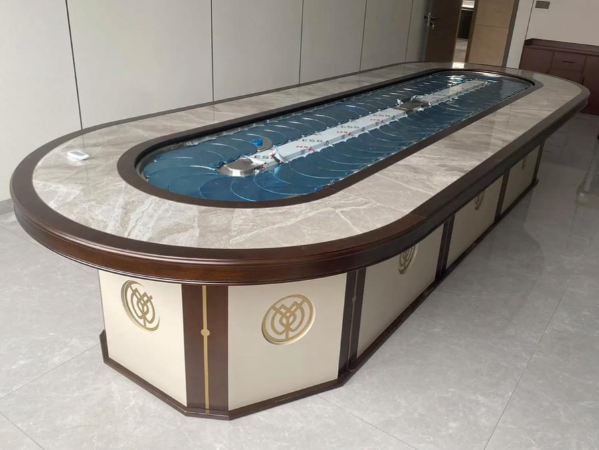
3. Revolving Sushi/Conveyor Belts: Continuously rotating strip or circular belts, synchronously controlled by multiple drive systems.
4. Display Turntables: Used in shop windows and showrooms. Emphasis is placed on exquisite appearance, wide speed range (allowing for extremely slow rotation), quiet operation, and often combined with lighting effects.
5. Industrial Turntables: As part of automated equipment, emphasizing positioning accuracy, repeatability, rigidity, and programmed control.
---
Part Two: How to Choose an Automatic Turntable
When purchasing, please follow these steps and key points to ensure you buy the right product.
Step 1: Clarify Core Needs (Application Scenarios and Budget)
· Where will it be used? Family gatherings, restaurant private rooms, large banquet halls, product showrooms, or factories?
What will be displayed? Ordinary dishes, heavy sculptures, precision instruments, or hot pot equipment?
What is the budget range? Prices vary widely, from a few hundred yuan for a basic home model to tens of thousands of yuan for a heavy-duty commercial model.
Step Two: Determining Key Technical Parameters
1. Size and Load Capacity (Crucial)
* Tabletop Diameter: Determined based on the actual tabletop or required display area.
* Maximum Load Capacity: This is the safety limit. It is essential to estimate the maximum possible load (including the tabletop's own weight, items, and pressure from people leaning on it), and select a model with a 20%-30% margin. For example, if the estimated maximum load is 200 kg, choose a model with a load capacity of ≥260 kg.
2. Drive Method
* For home/light-load displays: Friction wheel drive is sufficient; it offers high cost-effectiveness and is sufficiently quiet.
• Restaurant/Heavy-duty commercial use: Gear-driven type must be selected to ensure long-term stable operation and avoid embarrassing slippage and stoppages.
• Ultra-high precision/zero maintenance requirements: Consider direct-drive type (if budget allows).
3. Power Supply and Functional Requirements
• Is electrical connection required? If a permanent connection to an induction cooker and lighting is required on the tabletop, a model with a slip ring (conductive slip ring) must be selected, and the rated current and number of channels of the slip ring (e.g., 5 channels, 10A per channel) must be confirmed to meet the needs of all equipment.
• Control method: Choose wired, wireless, or touch control according to convenience requirements. Wired remote control is recommended for restaurants (less likely to be lost). Smart sensor models can be selected for high-end showrooms.
4. Performance Parameters
• Speed range: Usually 3-5 adjustable levels (e.g., 1/2/3/4 rpm). Showrooms may require a wider range (e.g., 0.5-10 rpm).
• Noise level: Inquire with the seller about the decibel values of the motor under no-load and full-load conditions. High-quality products should operate below 40 decibels (similar to a library environment).
• Operational Smoothness: Review demonstration videos or examine the actual product to observe smooth operation during startup, shutdown, and uniform rotation, without any jerking or vibration.
• Power Supply and Power Consumption: Confirm that it uses a safe DC voltage (e.g., 24V), and that power consumption is typically low (tens of watts).
Step 3: Examining Quality and Details
1. Motor Brand and Type: A core component. Prioritize low-noise synchronous motors from well-known brands for longer lifespan and greater stability.
2. Bearing Material: Slewing bearings are superior to ordinary ball bearings, offering stronger load-bearing capacity and resistance to tipping.
3. Structural Manufacturing Process:
• Body Material: Metal bodies (e.g., aluminum alloy, steel) are superior to all-plastic bodies, providing better heat dissipation and preventing deformation.
• Gear Material: Metal gears (especially copper and steel) are superior to plastic gears, offering better wear resistance and durability.
4. Safety and Protection Functions:
• Does it have overload protection (automatic stop upon jamming)? • Does it have leakage and overheat protection?
• Does the structure have an anti-pinch design?
5. Noise Level Test: If possible, listen to the operating sound on-site or via video.
Step Four: Brand, Service, and Installation
1. Brand and Reputation: Choose a brand with a good reputation and successful case studies in the target market (home or commercial) for better quality and after-sales service.
2. After-Sales Service: Clarify the warranty period (usually 1-3 years for core components), warranty coverage, and whether on-site repair service is provided.
3. Installation and Compatibility:
• Confirm the compatibility of the turntable with the existing table (e.g., opening size, fixing method).
• Understand the installation complexity; some heavy-duty commercial models require professional installation.
Purchase Summary Checklist
Consideration Dimensions: Home/Light Display, Restaurant/Heavy Commercial, High-End Precision Display
Core Requirements: Quiet Operation, Aesthetics, Cost-Effectiveness, High Load Capacity, Durability, Stability, Extremely Quiet Operation, Extremely Smooth Operation, Precise Speed Control
Drive Method: Friction Wheel Drive, Gear Drive (Required), Direct Drive or Precision Gear Drive
Load Capacity Requirements: Actual Load + 30% Margin, Maximum Possible Load + 50% Margin, Equipment Weight + Sufficient Margin
Power Supply: Basic Model Required, Slip Ring with Sufficient Current Strongly Recommended, Slip Ring Optional Based on Equipment Requirements
Control Method: Wireless/Wired Remote Control, Wired Remote Control (Anti-Loss), Touch/Smart/Program Control
Budget Level: Low - Medium, Medium - High, High - Very High
Final Recommendation: For commercial or critical applications, don't just pursue the lowest price. The embarrassment, customer complaints, and repair costs caused by a turntable that jams or breaks down at a critical moment far outweigh the initial price difference of purchasing a reliable product. Investing in a robust, reliable automatic turntable is key to long-term peace of mind.
 XINDA
XINDA